

Archives

The AA Archives Category

welcomes members interested in or curious about Archives. Ask questions, share comments, and join the discussions. We hope you find useful information here.

Basically, Archivists and AA members can share experience, strength, and hope. Together, we explore how technology supports archives work. AA service structure, literature, and documentation have moved to digital formats. This affects home groups, Districts, Intergroup/Central Offices, Areas, and GSO/AAWS.

Maintaining archives for future generations has grown more complex. Essentially, members need more ways to share ideas and simplify the work. A national Archives workshop meets each year. Conversations that start there can continue year-round in the Forum.

Below are links and information many of us have found useful.


About the National A.A. Archives Workshop​

The National Alcoholics Anonymous Archives Workshop (NAAAW) launched in 1996 in Akron, Ohio. Specifically, the first meeting took place at the historic Mayflower Hotel. A dedicated group of Archivists drove its creation. These volunteers work within General Service, Intergroup, and Institutions structures across North America and beyond.

Above all, we draw inspiration from Nell Wing, AA’s first General Service Archivist. Though a non-alcoholic, she set the standard all subsequent GSO Archivists have followed.


AA Archives Workbook (M-44i)
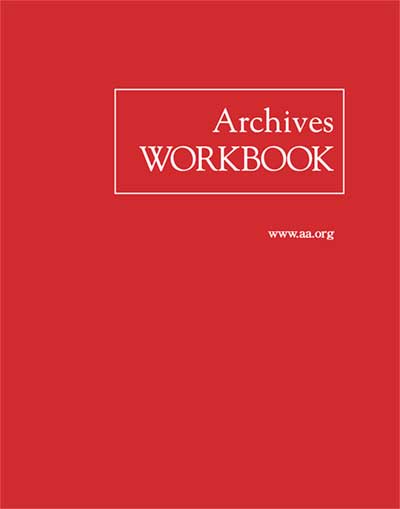
For AAs interested in service in archives, this workbook offers shared experience.  Committee activities, setting up a repository, preservation, copyright, collecting oral histories, and more are covered. It also provides information about accessing materials in the GSO Archives.

AA Archives – General Service Office 

The mission of the Alcoholics Anonymous GSO Archives is to document permanently the work of Alcoholics Anonymous.  Additionally, they make the history of the organization accessible to A.A. members and other researchers.  Hence, they also provide a context for understanding A.A.’s progress, principles, and traditions.

Purpose

AA’s primary purpose of maintaining our sobriety and helping other alcoholics achieve recovery.  Consequently, the Archives of AA will:

  • Receive, classify and index all relevant material, such as administrative files and records, digital materials, correspondence, and literary works and artifacts considered to have historical importance to Alcoholics Anonymous;
  • Hold and preserve such material;
  • Provide access to these materials, as determined by the archivist in consultation with the trustees’ Archives Committee, to members of AA and to others who may have a valid need to review such material. This is contingent upon a commitment to preserve the anonymity of our members;
  • Serve as a resource and laboratory to stimulate and nourish learning;
  • Provide information services to assist the operations of Alcoholics Anonymous;
  • Promote knowledge and understanding of the origins, goals and program of AA.

Adopted: October 30, 2006 by the General Service Board of Alcoholics Anonymous (revised January 2021)

The Idea

The idea for organizing a historical collection of the Fellowship’s records came from co-founder Bill W. in the early 1950s. Bill was becoming increasingly concerned that “the history of Alcoholics Anonymous is still veiled in the deep fog.” Knowing that the office correspondence was loosely maintained in the drawers at the General Headquarters, he set out to arrange our historical records. He personally recorded oldtimers’ recollections in the Akron/Cleveland area; he sent out boxes of blank tapes to others, encouraging them to record their recollections. Bill’s far-reaching vision outlined an archival message that is still sound today.

Bill W’s Perspective

He said: “Every one of the new and unexpected developments (in A.A.) has, lying just underneath, an enormous amount of dramatic incident and experience—stories galore.… It isn’t hard to prepare a fact sheet of what happened— that is, dates when people came in, groups started, and so forth. The hard thing to lay hold of is the atmosphere of the whole proceedings and anecdotal material that will make the early experience alive.” After many decades of tireless organizing and arranging, the G.S.O. Archives room was opened with a formal ribbon-cutting ceremony in November 1975.

Since then, the G.S.O. archivists and the trustees serving on the Archives Committee of the General Service Board have encouraged the importance of archival service, which is vital to the survival of the Fellowship. As a result of that work, today almost all areas have set up archival collections, and there is a significant growth at the district level. Historical records help us to sift through our day-to-day experience in recovery and reach back for the shared experience from the past.

Instructions for Completing this Form

Name:

The name you use here is not verified and only used to control for spam and bot submissions. It will not be tied to your account. You can create and edit a profile disclosing the account name and information you wish to expose to the community (not publicly visible outside the forum) when and after you join.

Email:

Email where the invitation to join will be sent. This will also become a secondary way of logging in or recovering your password. We recommend a personal email address (e.g. your_name@example.com) instead of a “positional” email address (e.g. webmaster@your_intergroup.org) unless you intend for you membership to rotate with the person holding the position in the future. This email address can be changed after you join if you wish to change it by editing your profile information.

Affirmation:

By the group conscience of the members, this forum is only open to members of AA and those non-members of AA supporting AA services (e.g. Intergroup offices, AA service structure, etc.).

Topic Interests:

If you are interested in conversations in more than one  technical topic area (e.g. web sites, answering services, virtual meetings, etc.) or have a general curiosity about AA discussions in general (e.g. topics above and beyond technology like committees and group dynamics), you would probably want to select the default “General” option.

If your primary interest is in Archives only, you probably want to select the “Archives” option. Note that with either option, you will still have access to all topics on the forum but with the “Archives” option, your “home screen” will automatically place you in the “Archives” category where most of those conversations happen.